
RUNNING FORM
What is a good running cadence?
A good running cadence is individual, not automatically 180
Cadence is the number of steps you take per minute. A useful cadence depends on pace, body proportions and your movement; 180 steps per minute is not a universal requirement for efficient running.
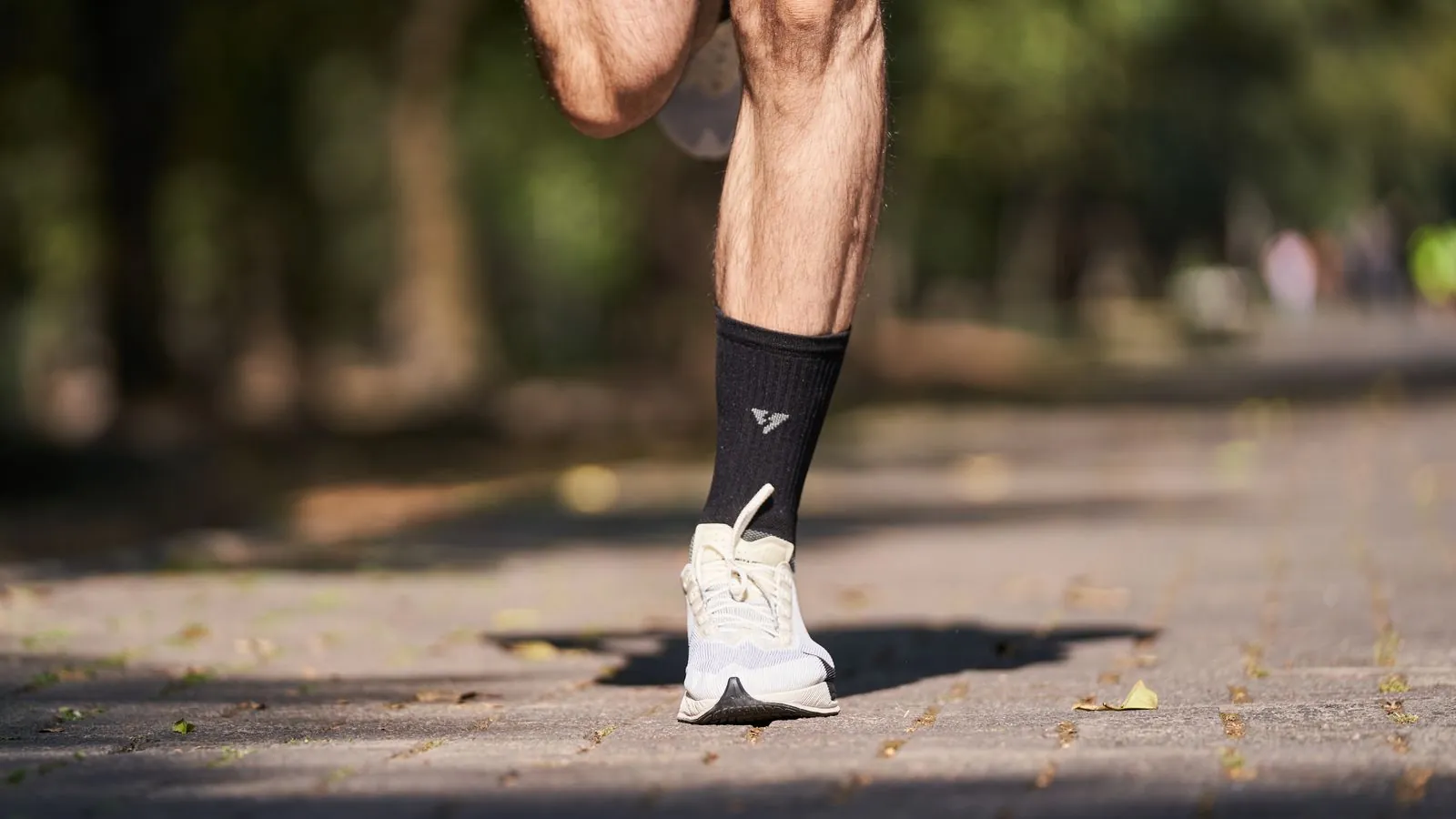
Read the unit first
Most running summaries express cadence as total steps per minute across both feet. Some devices or exports may describe strides or report a one-sided count. A value around half of what you expect may therefore reflect a convention rather than an extremely slow step rate.
Before comparing numbers, check the source and the definition. Also check whether walking, stops and the warm-up contribute to the displayed average. The average of an entire outing is not necessarily the cadence of its steady running section.
Speed connects step rate and step length
When cadence counts both feet, speed equals steps per second multiplied by distance per step. This is ordinary kinematics, not a prescription for how long your steps should be.
| Cadence | Distance per step | Approximate speed |
|---|---|---|
| 160 steps/min | 1.125 m | 3.00 m/s |
| 180 steps/min | 1.000 m | 3.00 m/s |
Both examples equal 10.8 km/h, roughly 5:33 min/km. A higher cadence does not automatically mean a faster runner, because step length also changes. These invented combinations illustrate the arithmetic; they do not measure running economy.
What cadence research can and cannot say
Heiderscheit and colleagues studied small changes around each runner’s preferred step rate at a constant treadmill speed. Increasing it changed several joint-loading measures. That is a much more specific finding than “everyone should run at 180.”
A laboratory change in loading is not a guarantee of injury prevention or better race performance. Changing gait can move demands elsewhere. If you are changing cadence to manage pain, work with a qualified clinician rather than using a watch target as treatment.
Compare the same kind of running
Compare steady sections at similar speeds on similar terrain. An uphill jog and a downhill stride ask for different movement. If speed changes across your sample, an apparent cadence trend may simply reflect that change.
Do not force a large increase to match a number from an elite race broadcast. An awkward shuffle or excessive tension is not an improvement just because it produces the desired display. Comfort and the reason for the change should remain central.
Use cadence as context
If a compatible recording supplies cadence, Runome can place that data beside the other available activity metrics. Inspect the relevant running portions rather than assuming a whole-activity average describes every step.
If the metric is absent, check whether the source recorded and supplied it. A route file cannot reveal a measured cadence stream that it never contained. For progress reviews, compare a suitable pair of runs and keep cadence as one observation among several, not a grade for your running form.