
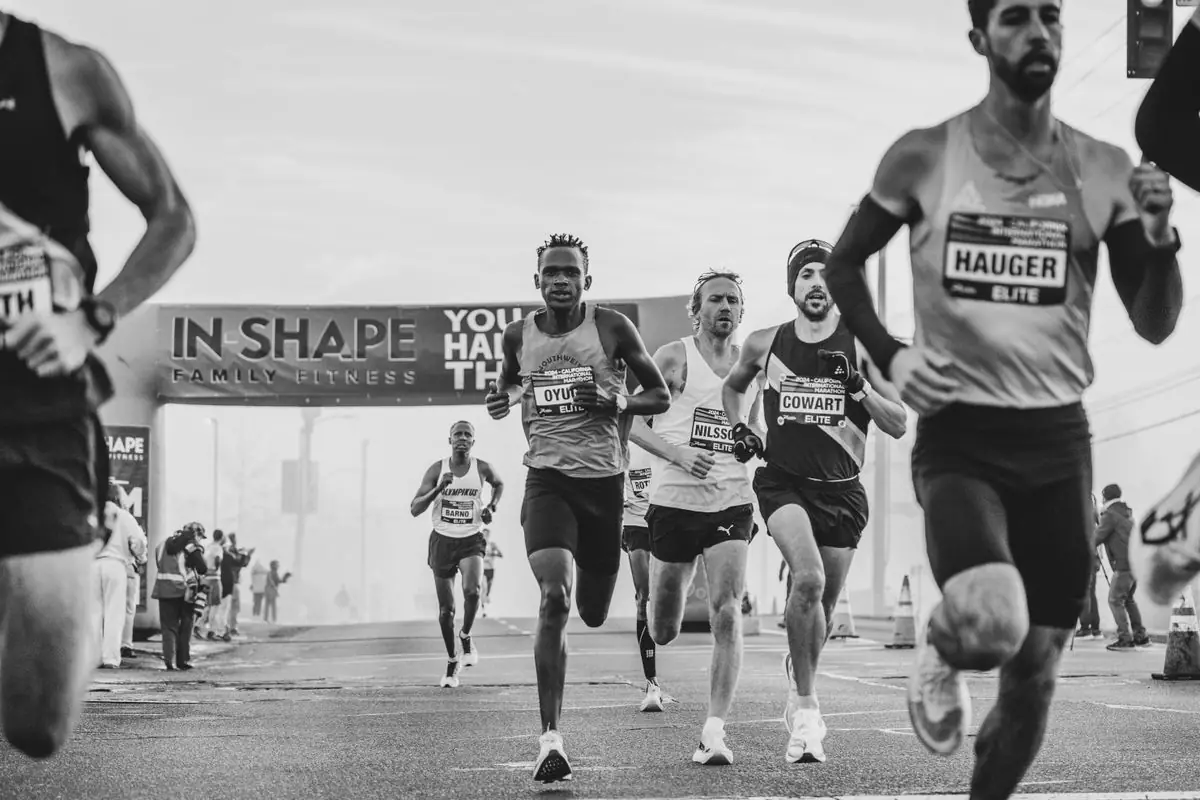
Every run contains a pace. Very few runs are honest tests of race performance. A useful prediction begins by knowing the difference.
NOT EVERY RUN IS A TEST
An easy run should not become a race forecast.
Runome race predictions help you explore target times from your running evidence. A recent race or time trial provides a clearer point of reference than the pace of an ordinary easy run.
If no qualified performance exists, the correct state is “No qualified performance yet.” Producing a confident-looking time from weak evidence would be more misleading than producing no time.
Was the source run intended or measured as a meaningful performance?
Is the observed effort close enough to the target to support conversion?
Is the performance current enough to represent today’s capability?
For long targets, does the training history support sustaining the projection?
CONVERSION WITH CONTROLS
A mathematical projection still needs restraint.
Race-time projection connects an observed performance with a different distance. The public Riegel model is one familiar example: its distance ratio illustrates why doubling the distance does not usually mean simply doubling the time.
That public model helps explain the idea of extrapolation; it does not describe Runome’s prediction method. Use the in-app estimate alongside your recent results, long runs and the demands of the target race.
Conceptual illustration. It does not display a predicted time.

A SECOND NUMBER MATTERS
Confidence describes the bridge from evidence to target.
Read the confidence shown with an estimate before treating its final seconds as meaningful. Recent, relevant performance evidence is a stronger reference for race planning than a distant or unrepresentative effort.
Multiple current, qualified efforts with close distance specificity.
A distant target with stale evidence and limited long-run coverage.
Confidence is not a promise that race day will match the estimate. Course profile, weather, pacing, fueling and whether the source effort was truly maximal remain outside the equation.
PREDICTION ≠ READINESS
Capability and preparation are related, not identical.
Explore a possible finish time from your running evidence.
Adds recent volume, long-run distance, frequency, consistency and recency for the target.
A runner can have the speed for a target without the recent endurance needed to sustain it. Runome keeps those questions separate.
READ THE SOURCE RUN
Treat the estimate as a traceable hypothesis.
Start with the source activity. Was it recent, representative and genuinely hard? Then inspect confidence and the distance gap. For long races, check whether volume and long-run evidence support the projection.
Use the time to frame a target, not guarantee an outcome. When no qualified evidence exists, create better evidence before asking for a sharper number.
The honest prediction is not always a finish time. Sometimes it is a clear explanation of what evidence is still missing.