
THE NUMBERS EXPLAINED
Running progress in percentages: what does 10% better mean?
A percentage needs a starting value and a named measure. Without both, a promising improvement can be surprisingly hard to interpret.
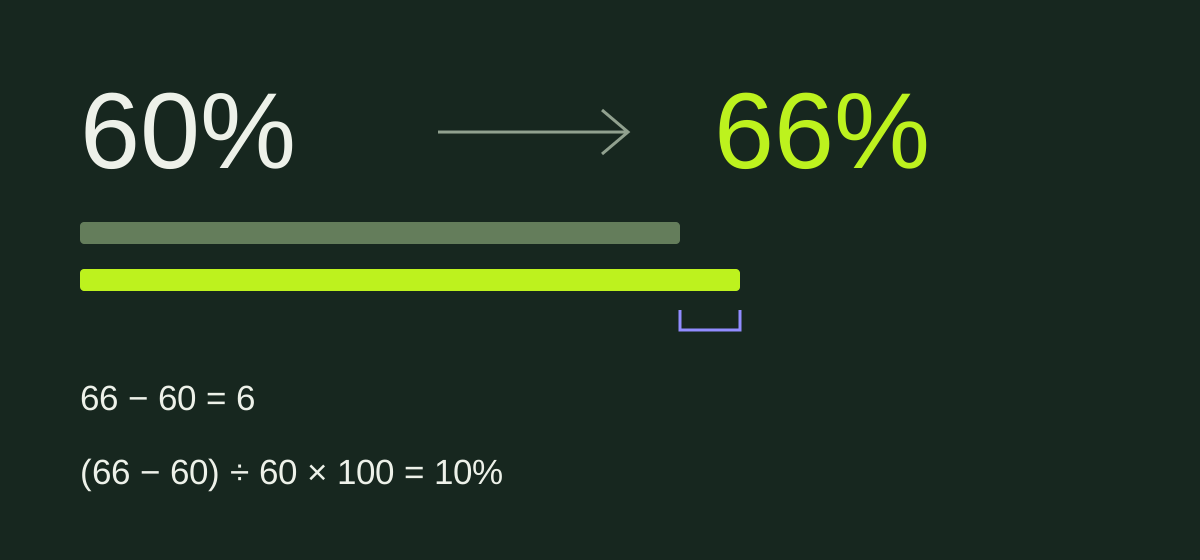
Percentage points describe the gap
Suppose time in a chosen heart-rate zone rises from 60% to 66% of two equally long runs. The increase is 6 percentage points. Relative to the original 60%, the increase is 10%: (66 − 60) ÷ 60 × 100. Both statements are correct, but they answer different questions. The UK Office for National Statistics makes this same distinction in its guidance.
Make the zone example tangible with two 50-minute runs: 60% means 30 minutes and 66% means 33 minutes. The difference is three minutes. If the runs had different durations, the same percentage-point change would not necessarily represent the same change in minutes.
Speed and pace are reciprocals
At 5:00 min/km, speed is 12 km/h. Increasing speed by 10% gives 13.2 km/h, or about 4:33 min/km. That is a 9.09% reduction in time per kilometer, not 10%. Conversely, reducing 5:00 by 10% gives 4:30 min/km, equivalent to about 13.33 km/h: an 11.11% increase in speed.
Check the arithmetic with the pace calculatorThe denominator matters
A rise from 20 to 30 km is 50%; returning from 30 to 20 km is a fall of 33.33%. The distance difference is the same, but the starting value changes. A percentage change from zero is undefined. And a change in a bounded score does not automatically represent the same percentage change in fitness.
Name the change before judging it
When comparing activities in Runome, begin with the actual units: seconds per kilometer, beats per minute, distance or duration. Then state the baseline and the direction. “Six seconds less per kilometer at a similar heart rate” is a clearer observation than “2% better.” Whether it reflects progress still depends on comparable conditions and repeated evidence.
Explore run comparison in Runome